
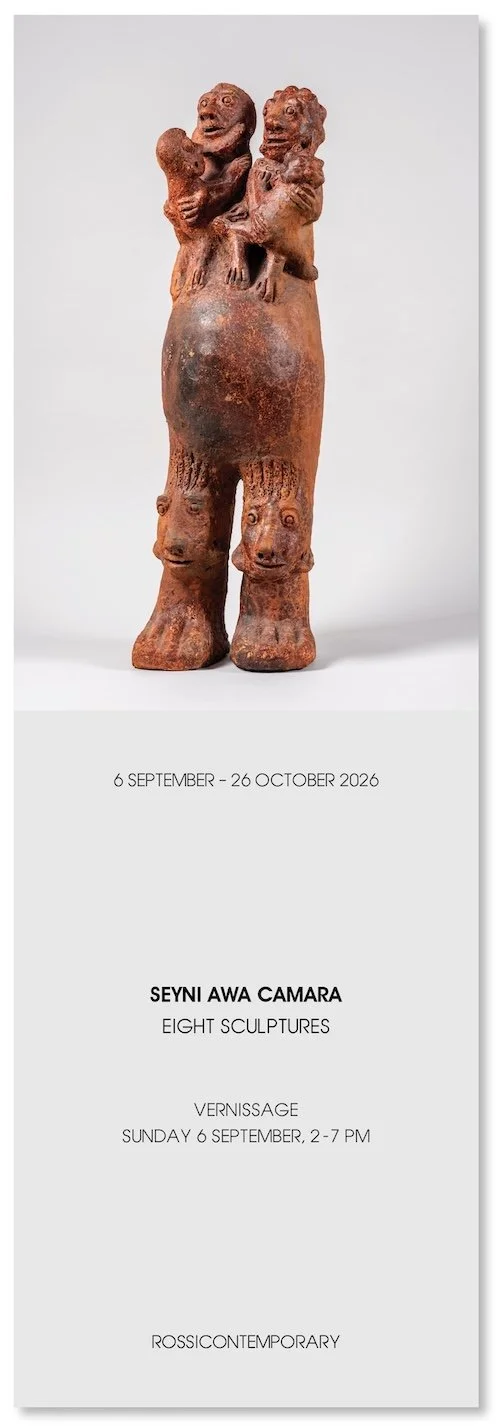
SEYNI AWA CAMARA
EIGHT SCULPTURES
A self-taught and unclassifiable artist, Seyni Awa Camara passed away in early 2026 in Bignona, Casamance (Senegal). She left behind a unique body of work that has become essential to the history of Senegalese art and is celebrated worldwide as one of the most significant on the African contemporary scene.
At the start of this season, Rossicontemporary is pleased to present eight terracotta sculptures by the artist. The exhibition brings together three large protective figures - a teeming maternity scene and two hybrid totemic creatures - as well as five pieces inspired by everyday life, combining domestic animals and modes of transportation.
Seyni Awa Camara practiced direct modeling, bare-handed, without sketches or armatures. Far more than a mere material for expression, clay was the locus of a plastic metamorphosis and a symbolic reparation. Each sculpture was born from an inner impulse, guided by spiritual resonances, the memory of ancestors, and the observation of daily life. Without a prior plan, the gesture originated from the raw mass to continuously bring forth the form, allowing visions to spontaneously embody themselves in the fresh material. Through adding and smoothing, the volume progressively came to life guided solely by the intuition of her fingers. Documentaries, accessible online, bear witness to this creative process, capturing the artist’s gesture from the very first piece of clay to the final result.
This physical and ritualistic approach extended into a spectacular firing process: installed outdoors in a flaming pit, the pieces were extracted red-hot and then immediately immersed in a plant-based bath of fermented pods. This thermal shock imparted a durability as well as the characteristic dark and reddish patina.
Marked by painful maternities in Diola country - where fertility dictates social status - the artist reinvested the traditional kagnalène rite, designed to ward off bad luck and protect life. Her two-headed bodies, her teeming figures laden with children, and her faces of enigmatic frontality assert a powerful presence, where the aggregation of forms gives body to the intimate trials. Initially marginalized by those around her, she found essential support in her second husband, the healer Samba Diallo, who became the protector of her creation and the mediator of her work to the outside world.
Initiated into utilitarian pottery from childhood, she quickly broke away to create a free statuary of complete formal independence, which was initially met with mistrust by her peers. In the face of reluctance, she countered with a founding myth: a secret initiation with the forest spirits, who came to impart to her the mysteries of working the earth.
Selling her pieces on the local markets of Casamance throughout her life, Seyni Awa Camara experienced a major turning point during her participation in the historic exhibition Magiciens de la terre at the Centre Pompidou in 1989. This event catapulted her practice onto the global stage. Without ever leaving her home in Bignona or altering her way of life, her work quickly entered prestigious public and private collections around the world. Her trajectory has inspired an abundant critical reception, supported by monographic publications, art history essays, and audiovisual documentaries.
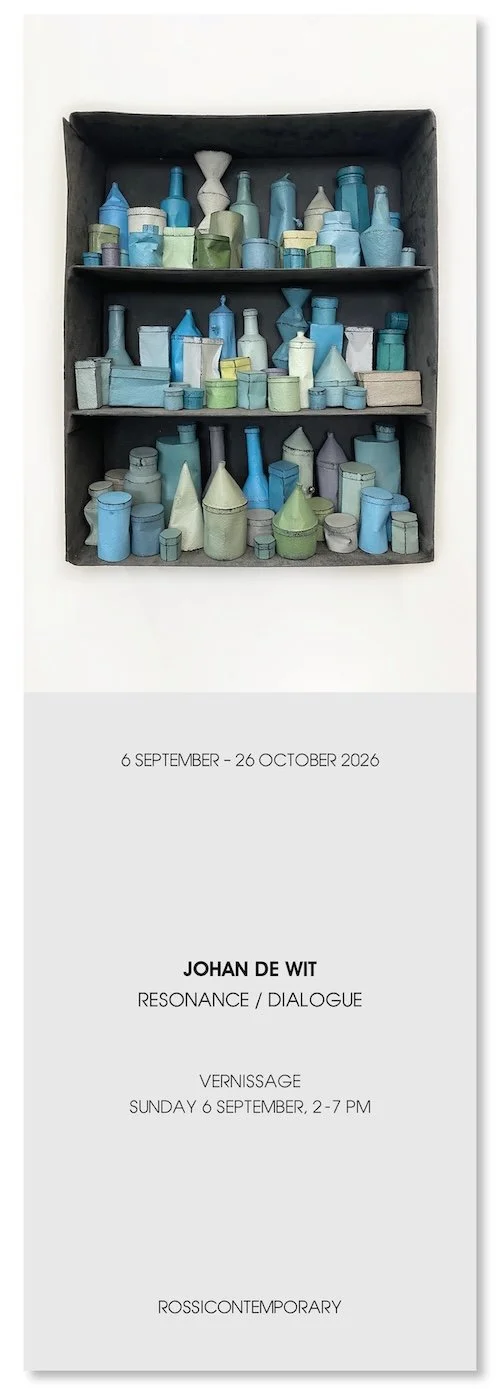
JOHAN DE WIT
RESONANCE / DIALOGUE
For his third solo exhibition at Rossicontemporary, the Ghent-based artist presents two emblematic bodies of work: the Cupboards, dressers filled with hundreds of bottles, pots, and vessels, and his "canvases", featuring folded and curled surfaces.
The dressers form a true three-dimensional calligraphy, extending the quietude of classical still lifes into an alignment as dense as it is fragile. Meanwhile, the wall pieces, freed from the rigidity of the traditional form, transform the pictorial plane into a vibrant body that catches the slightest ray of light to reveal its indentations and imperfections.
Through these simplified shapes reconstructed from memory - pots, boxes, paintings - Johan De Wit develops a reflection where sculpture is conceived first and foremost as a pictorial gesture. Here, there is no rupture between volume and surface: the third dimension provides a plane on which light acts like the touch of a paintbrush.
This sensibility is particularly evident in his unique approach to color, which reveals his deep passion for the Old Masters: from the Flemish Primitives to the Italian Renaissance, through to modern painting up to Giorgio Morandi.
In his work, color does not appear to be applied onto the object; it becomes one with the material. Formulating his own shades using natural earth pigments, ochres, and ground minerals combined with chemical reactions, the artist imparts an astonishing depth to each piece. The sculptures originate from a lightweight paper armature, infused with acrylic resin, marble powder, and iron powder. Shaped by hand during drying to create natural sags, they are painted in subtle tones of off-white and eggshell, or even a full range of blues, yellows, greens, reds, and grays. Therein lies the paradox of his work: offering a minimalism that is neither abstract nor fixed, but alive, tactile, and molded by time.
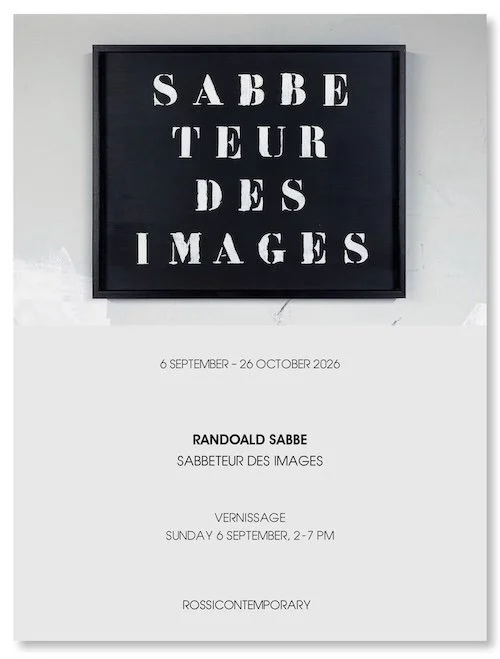
RANDOALD SABBE
SABBETEUR DES IMAGES
On the occasion of his first solo exhibition at Rossicontemporary, the Belgian artist Randoald Sabbe presents, under the manifesto-like title Sabbeteur des images, a vast collection of incisive and lighthearted works.
Since 2020, he is developing his practice through textual paintings, object assemblages, and hijacked signages. The selection offers an immersion into a strikingly agile approach, carried out with remarkable mastery : works that awaken the retina, engage the mind, challenge our cultural reference points, and reactivate our memories.
By seizing upon ordinary iconography (popular references, signage and commercial signs, everyday accessories, as well as familiar expressions), the artist probes the porosity of history, politics, and the sacred.
Between language and image, a refined dialectic takes root that hides as much as it reveals: the artwork suggests by concealing and thus transforms the visitor into an active interpreter. An art imbued with humor, conceived as a poetic vector capable of reconfiguring, shaping and ultimately emancipating reality from its confines.
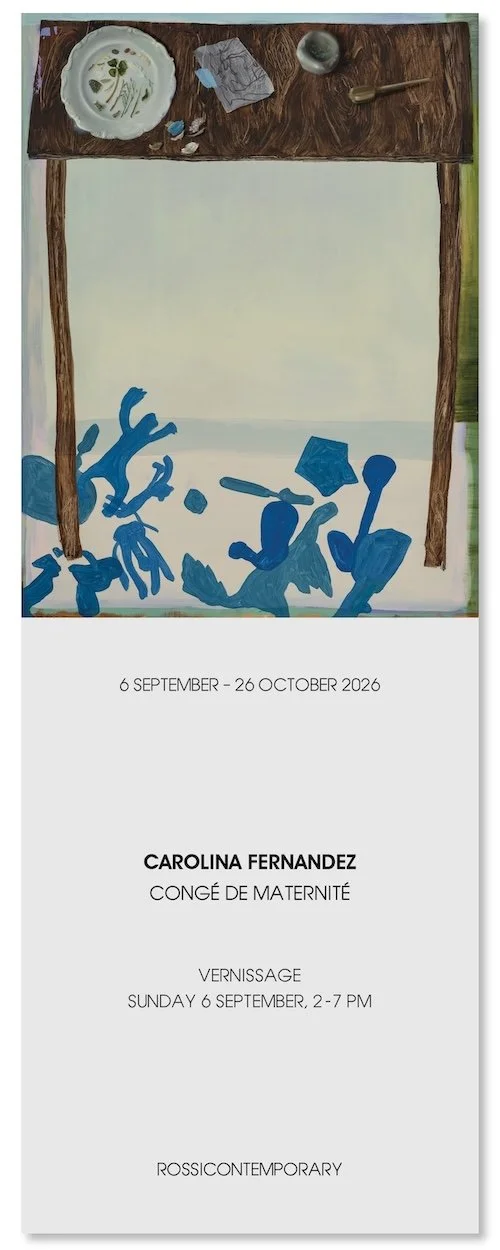
CAROLINA FERNÁNDEZ
CONGÉ DE MATERNITÉ
My practice changed with the arrival of my children. I gained a new identity of self as a mother, but also grieved for my previous way of being and thinking. It is now a moment to revisit my own childhood, and experience it differently.
Having a child is a second opportunity to look at the world as if for the very first time.
After an absence of several years from the art scene, Carolina Fernández returns to Rossicontemporary to present Congé de maternité, a solo exhibition bringing together a dozen new oil paintings. With this highly anticipated return, the artist addresses a period of pause and transformation, exploring themes such as play, suspended time, creation, and the reclaiming of self. The twelve new works presented reveal a vibrant take and an intimate sensitivity, navigating between figuration and an emotional realm.
For Carolina Fernández, 'maternity leave' goes beyond a simple temporary pause, it is a new dimension of existence and a permanent state of transformation. Becoming a mother demanded the relinquishing of a past way of being that made room for a new vulnerability, both physical and emotional, while disrupting the myth of the artist isolated in her studio. Suddenly, creating and mothering must coexist between the cries, meals, diapers, and the unpredictability of daily life where time grows scarce. Akin to an athlete forced to adapt their movement, the artist traded her former working rituals for a more direct form of painting, driven by the rhythm of interruptions, pauses, and urgency. Fernández has thus developed a practice focused on deeply personal subjects.
Through scenes of daily life and intimate narratives, everyday existence weaves together with memories, games, music, and stories from her childhood in Colombia. Every detail tells a story and celebrates the small things. The visual vocabulary of the paintings emerges partly renewed by the arrival of new familiar objects from here and elsewhere: toys, baby monitors, figurines, paper cutouts, stickers, or recipes. They now sit alongside those animal figures so dear to the artist, embodying a raw strength and instinctive wisdom. We also find the symbolic motifs distinct to her work, such as dog silhouettes and Elizabethan collars for animals - images of illness and healing, acceptance and transition, symbolizing the vital need for the other.
Between Colombia and Belgium, Fernández’s work navigates amongst the ordered introspection of her adopted country and the overflowing, shared vitality of her homeland. The echoes of popular music, from Cuban songs to memories of the lambada in Bogotá, intertwine with themes of memory, motherhood, and a sense of resilience. Formally trained in fine arts, her painting is distinguished by its sensitive execution, attention to detail, and rich symbolism. Behind the apparent gentleness of the scenes lies a meditation on existence, offering a perspective imbued with humor, nostalgia, and hope regarding transmission and the passage of time.
Quisque iaculis facilisis lacinia. Mauris euismod pellentesque tellus sit amet mollis.